When the Machine Age gears up to destroy a whole generation of men tethered to machines and poverty in Europe, it gets Dada, Max Ernst and Otto Dix, and Pierrot Lunaire.
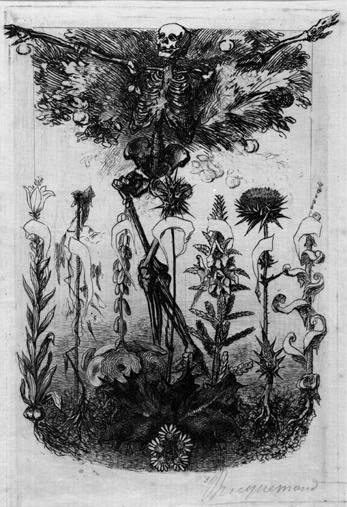
Perspectives change; they become radicalised. So where Goya depicted even something evil - a witches' sabbath, with Satan to boot - using a colour scheme which now would trick us into believing that beauty = sympathy, the Generation of 1918 reduced the splendour of a landscape or the heroism of war into something suspicious and sinister:
The glories of Classicism from the early Industrial Revolution become nothing more than the glories of the class whose lust for honour and glory and wealth took the peasant and incarcerated him in the factory, and then sent him off to fight a war from which few of his number returned. Beauty becomes suspicion; form becomes function.
The ideals of the age are stripped away and the bare reality is exaggerated. Schinkel's classicism gives way to the astringent Bauhaus.
It took over one hundred years of middle-class liberalism (1789-1918) to make the transition from Romanticism to 'pure' Modernism; from the early revolutionary promise of the French Revolution, which provided so much hope to Wordsworth and Coleridge in England, and Hegel and Hoelderlin in Germany, to the disillusionment of the first of the Western 'Peloponnesian' Wars 1914-1918. Gyorgy Lukacs referred to this as the transtion of the bourgeois from its heroic period to its unheroic period in his 1934 essay on Hoelderlin - from the Bastille to Bernard Baruch, in our view.
How does one then characterise the post-Cold War age? Cursorily, it feels like a later development of seeds already sown in earlier ages. All political life is subordinated to the management of the economy (cf. global sovereign debt crisis and austerity) - as in the Weimar Republic; high finance is ubiquitous and troublesome, as in President Jackson's age; globalisation proceeds apace (forseen by Marx in part one of his German Ideology); cultural cynicism is as strong as after the Great War; democracy and the problem of the citizen unleashed by Bastille is more widely spread; technology is as unavoidable as when the Luddites smashed their first machines in England.
Intensification and exhaustion perhaps characterise our age.
Burning Pyre's next post will test the proposition that 'every age gets the art it deserves' and attempt to falsify its conviction that our age - call it what you will - is an intensification of long-lived trends and is as a result exhausted.
Burning Pyre is sick of the serviette badinage which passes for trench warfare between modern
media talking heads. We’ve read of the time when men would beat and shoot each
other to death over their opinions, viz. 1919:
What are we trying to say, ever so clumsily? That the cultural commentator
and artist should stop whispering behind his napkin, embarrassed by a ballsy opinion, and
say something real.
The New Arcades Project is an attempt to understand – hell:
appreciate – art, politics, philosophy, history, economics, etc, etc, within a fragmented
narrative context which is not history, but nevertheless seems like history.
The rise of new media means that a new understanding can be developed which is
not based in the art gallery or in the venerable book (which we continue to
venerate, Amazon’s space-saving toy be damned) and, thanks to its brevity, need
not be monotonically classicist or Marxist or fascist or capitalist or –ist at
all. It can interweave competing, fragmented narratives to present a
mosaic-like picture of events. It is the theory of history for an over-intellectualised, over-stimulated, over-fed generation who do not know what war or political rioting is, but who wish to understand the past more viscerally and without regard to political correctness or narrative structure than a million History Channel reconstructions, based on a phenomenological bootstrapping of personal experience to general, 'public' experience.
What the fuck does this mean?
We all remember the time, however distantly, a great record was released; an artwork seized the headlines; a terrorist event gripped our attention and our pity; a magnificent moment which was greater than our own personal agendas and felt, yes, like the Zeitgeist itself! This is the New Arcades Project.
This is a continuation of our retronauting back to the 70s with
Bernhard’s Correction (’75), Eno’s Ambient 1 (’78) with the glam roots of the decade.
This is what really kicked it off:
Men
wearing makeup? Do well to note that this is what life in the early 70s was like:
While glam rock just looks old-fashioned and silly to most people now, underlying its outward daftness is the desire not even twenty years after the creation of rock n roll to lionise stardom and to play
with the concept of it. It wasn’t enough simply to be the star, to play the
music, to sell out Shea Stadium – you had to differentiate yourself from the ordinary people and give
vent to their (supposedly) subconscious desires to break free and live as if
you had the money to do it. Like this:
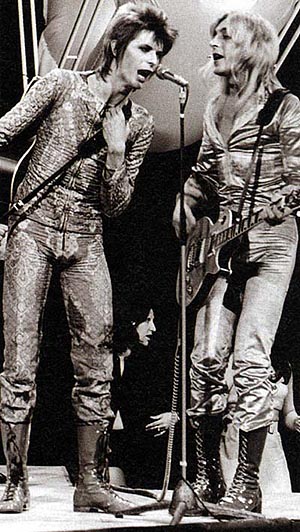
So glam was born, the next rebellion of the slightly-younger of the same generation (Bolan and Bowie were only 7 years younger than Lennon). T-Rex were the first and best and Bolan even did the courtesy
of dying before he was thirty, cementing his legend as the leader of his pack, but Ziggy Stardust is the real hero of glam rock, and his roots are much, much older than rock n roll.
The writers J-K Husymans, Octave Mirbeau and Wilde had long satirised the
hedonistic bent of fin-de-siècle France and Victorian Britain; glam was a
recrudescence of this kind of flared-cuff-and-top-hats approach to aesthetics
and desire, indulging as far as possible in all the bad taste glitter and glitz
that could be found in a still-industrial Britain. Bowie/ Ziggy’s Rock n Roll Suicide even incorporated
the same moral resolution that Wilde adopted in The Portrait ofDorian Gray - a debauched Ziggy is torn to pieces by his fans - although admittedly Jones/Bowie/Ziggy’s influence was a melange inspired by the youthful demise of Buddy
Holly, Brian Jones, Morrison, Joplin and Hendrix. And the Americans landing on
the moon. And Vince Taylor.
That glam was a revival of older music there can be no doubt: listen to the
blues and 50s rock n roll riffs in T-Rex, cribbed from the States and cranked
up to 10, and songs like Cadillac and
Thunderwing (these aren’t British
cars), they’re all poses (Bolan couldn’t even drive). The smooth ballading of
Ziggy, cribbed from Sinatra and the 60s (and the 30s’ Wizard of Oz, in the case of Starman)
and his rockers, which sound like Hendrix wrapped in foil and without the wah-wah and
fuzzbox pyrotechnics, hark back to a simpler, purer era, stripped down to an essence bottled in prior decades.
The point here isn’t that pop will eat itself; glam was original, for all its references to
aesthetic history. It’s that it was the first successful ‘heroising’ sub-genre of music, to permit a coinage.
The rock n roll star as hero, as alien. Recall Baudelaire’s casting the role of
poet in L’Albatrossfrom the Flowers of Evil:
Often, to amuse themselves, the men of a crew
Catch albatrosses, those vast sea birds
That indolently follow a ship
As it glides over the deep, briny sea.
Scarcely have they placed them on the deck
Than these kings of the sky, clumsy, ashamed,
Pathetically let their great white wings
Drag beside them like oars.
That winged voyager, how weak and gauche he is,
So beautiful before, now comic and ugly!
One man worries his beak with a stubby clay pipe;
Another limps, mimics the cripple who once flew!
The poet resembles this prince of cloud and sky
Who frequents the tempest and laughs at the bowman;
When exiled on the earth, the butt of hoots and jeers,
His giant wings prevent him from walking.
The poet as self-conscious outsider,
raised above the common mass by his idealism and his sensitivity, alienated by the crude materialism of an increasingly affluent everyday life (the ahistorical amongst our readers will be shocked to read that pockets of Western Europeans in the 1860s thought their civilisation 'too affluent' prior to mass electrification, pre-radio, pre-TV, pre-Space Invaders, pre-Xbox, pre-Iphone, pre-Google glasses, but there it is). The sidereal
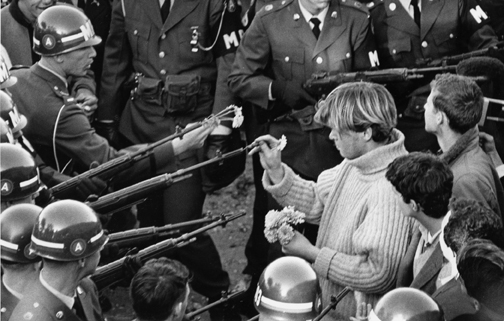
hero of Bowie’s Starman, who instructs Ziggy to spread the message of love and hope on earth, is glam rock's classic exemplar. It is not the same kind of peace and love spread in the 60s, by a generation who thought they were changing the world:
Admittedly, Jim Morrison was of the same ilk, and the influence of Rimbaud and the Imagists is less oblique in his lyrics than in glam. The Doors were literary, to be sure, but they differ ideologically from glam in that Morrison wasn't interested in the idea of the rock star; he was interested in the idea of the mage, the writer and the dark poet, but happened to be a rock star in a rock band.
The colour TV - introduced into Britain in 1967- helped glam's cause immensely, as it had the psychedelic movement. Ziggy Stardust in monochrome
would have looked like a bird shat on him, like a bad character from Dr Who; that would confuse the public, not enrage and inspire it:
Within a year, Roxy Music's Brian Eno
had chinned Bowie sonically with Here
Come the Warm Jets, at times redolent of Bonzo Dog Doo-Dah Band and their Carollian whimsy, in fact awash with clues about the aural horizon and
the invention of ambient music (see previous posts). But
Ziggy played guitar, and the kids saw
it – and that’s what counted, in this decade of oil crises, failure of the greatest Western power to bring down a nation of peasant-communists and growing social unrest. Tune in, turn on and drop out had failed, apparently stabbed to death at Altamont in December '69 and vapourised in Britain by increasingly virulent bombings by the IRA. The communal hippy dream had faded; the decadent dream of glamour rock n roll heroism is what replaced it. Baudelaire would have approved.
BP wants to grasp, like Walter Benjamin’s Arcades Project, the past, to a degree limited by the information it can procure on the past, about the experiences of the past in its cultural-political-economic context, when it can be bothered. But it’s not Marxist.
This week/ today it’s Music for Airports.
For hipsters and dorks alike, Eno rules. His ambient album, coming two years after ambient collaborations with David Bowie, and after the fiddlings of La Monte Young, Cage, Penderecki, and the drugged noodlings of Tangerine Dream, is the focal point of the ambient explosion.
In 1978, a few years after the modernising effects of the Equal Pay Act (in force 1975), decimalisation and EU membership (1973), the softening of England to women and foreigners, the decomposition of melodies into sounds, drones, textures became – interesting; beautiful, even. Eno composed public space music: functional, democratic, music for strolling and waiting in public venues. Benjamin would have approved: Eno is a flaneur’s composer, and the flaneur was the subject of the Arcades Project. But as the topic of wandering around enclosed shopping spaces became less interesting to us (the uglier the interiors of those buildings got), so perhaps music for airports will need to become music for space shuttles, for aliens – for whatever. As science fiction reminds us, we never get as far as we think as fast as we think.