Showing posts with label retronauting. Show all posts

Saturday, 2 March 2013

Call of Cthulhu and Lovecraft's themes: an essay (part 1)


"There are more things in heaven and earth, Horatio, than are dreamt of in your philosophy."


It is 1926.
The TV is demonstrated:


Mussolini is in power:

The General Strike takes place in the world's biggest empire:


The First War is a painful and recent memory of machines crushing men like insects and a whole generation of Europeans is raised almost fatherless. Communism has beaten off an international coalition and Stalin reigns supreme now that Lenin is dead. Oswald Spengler has already proclaimed in the wunderbuch of 1917 Decline of the West that the artistic and political culture of the West has petrified into an unalterable form of civilisation, of numbers and law-tables. Max Weber has identified the West’s administrative science of bureaucracy as an iron cage of an unfeeling, impersonal age. Franz Kafka has populated the iron cage with fictive victims. Freud sees cocks and fannies everywhere. Already more than forty years has passed since Nietzsche wrote the immortal warning, ‘God is dead.’ So to 1926: an American writer of pulp fiction named Howard Phillips Lovecraft writes a short story in the Gothic horror genre, called The Call of Cthulu.
Its publication in 1928 is not an historical event, but then works of genre – horror, romance, even science fiction – have never been historical events. Invariably genre works drop out of all but the history books of film, literature and stage as soon as the print is dry on the reviews. Whereas the near-contemporaneous Ulysses is talked about very much in terms of the historical context in which it was published; whereas the admittedly somewhat older Les Demoiselles d’Avignon is pointed at as a fateful ‘kink’ in art history’s path – so genre works are analysed generally without reference to the historical context in which they are created. Ulysses concatenates Freud, the death of god, the plethora of modern man’s leanings and his consequent exhaustion – it is timely; rechtzeitig. Les Demoiselles d’Avignon conjures up feelings of fragmentation and perspective which were thought – perhaps only subconsciously – but not yet expressed so forcefully. Perhaps that is the clue – art begets art. Cubism emerges from painting, bleeds into writing (Apollinaire, Faulkner, Wyndham Lewis); writing captures dream analysis and commits it to the canvas (Dali, Magritte); the news reels find their way into Dos Passos’s USA. Each cross-pollination provides extra momentum when viewed as Art with a capital ‘A,’ creating a sense of its own relevance and historicity.

But horror – a genre – remained mere entertainment, outside of the boundaries of serious art and a mere reflection of the times, not a commentary on them, as if entertainment could only unwittingly catch the diseases of the age and not diagnose them.
Works which have history on their side are specifically and consciously new pieces of work which challenge the canon; this is the way of art since at the latest the Romantic period in the late eighteenth century. A serious work of art separates its cause from its effect. By contrast, Chekhov’s Lady with the Little Dog, which Nabokov called the greatest short work in all Russian literature, is on the face of it a simple tale of forlorn attraction between strangers – a simple set-up which tells us that this story is not about new sensations or contraptions or geographies or creatures. To stretch the use of two of our ordinary terms, Lady with the Little Dog is ‘about’ forlorn attraction; its ‘proper sensation’ concerns something deeper, something which critics find more difficult to agree upon: modern alienation, perhaps; or hopes; or fate. It is this indeterminable quality which separates art from genre. It is quality which then separates accomplished works of art and genre from works which merely aspire to be art or genre, and which is outside of the ambit of this essay.

The horror genre – like all genre – is self-limiting. Its tropes almost anyone can enumerate with the minimum of fuss – and this in all probability is the cause of its being excluded from the serious arts. Horror plays to something primal and pre-existing in the human experience: horror is about what’s lurking in the shadows; it is about our fear of death; it is about our fear of the ugly and deformed. Lovecraft himself said that the ‘criterion of authenticity’ for a work of horror is ‘the creation of a given sensation,’[i] in which ‘proper sensations are excited.’ How? Through the creation of newer, weirder forms of dread. The history of the serious arts tells us that these are themes which need not do anything new in order to function correctly. Horror’s function is to create a sense of fear and foreboding, and sometimes terror. As a genre, it is autotelic. In beginning, middle and end, cause and effect are melded together into an alloy whose sole purpose is to ‘horrify’ the observer. The variety of modes and effects are what provides the genre its depth. The dread of a vampire – a charming parasite capable of reason, but cursed to live forever – and the terror of a zombie – Westernised as a fallen man, devoid of all reason and impelled by the slimmest residue of brute instinct – are qualitatively different modes and effects of horror. Crossover has long been part of the horror genre – theoretical battles set out by enthusiasts in a game which is not different in form from a debate between two philosophers about essence. What better represents the essence of horror – Frankenstein or the Wolf Man? Frankenstein meets the Wolf Man, Dracula versus Frankenstein – these two-for-ones are pitched like The Big Fight, each one a battle between different manifestations of the 'given sensation' of horror, each fight able to be settled only by the director's preference and the sympathies of the audience.


As a piece of Gothic horror fiction, this preamble is designed to show that the historicity of The Call of Cthulu is not in question – so why call it to account? The introduction is necessary because Call of Cthulu is as attuned to the spirit of the age as the invention of TV is the age in which it is created, and it has been ignored as such. Only if we understand the historical context in which it was written will be able to appreciate the subtleties of The Call of Cthulu – subtleties which, as will be shown, are ever more relevant as we moderns in our everyday lives sink ever deeper into fantasy worlds coloured more by rationality and, conversely, simulacra than by danger and risk and the weird.


[i] Lovecraft, Supernatural horror in literature.1. Introduction

Sunday, 6 May 2012

Glam decadence: 1970s Britain and fin-de-siecle Paris


This is a continuation of our retronauting back to the 70s with Bernhard’s Correction (’75), Eno’s Ambient 1 (’78) with the glam roots of the decade.

This is what really kicked it off:


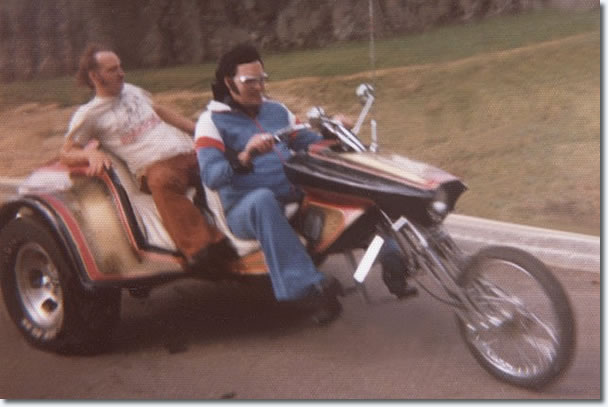
Men wearing makeup? Do well to note that this is what life in the early 70s was like:


While glam rock just looks old-fashioned and silly to most people now, underlying its outward daftness is the desire not even twenty years after the creation of rock n roll to lionise stardom and to play with the concept of it. It wasn’t enough simply to be the star, to play the music, to sell out Shea Stadium – you had to differentiate yourself from the ordinary people and give vent to their (supposedly) subconscious desires to break free and live as if you had the money to do it. Like this:


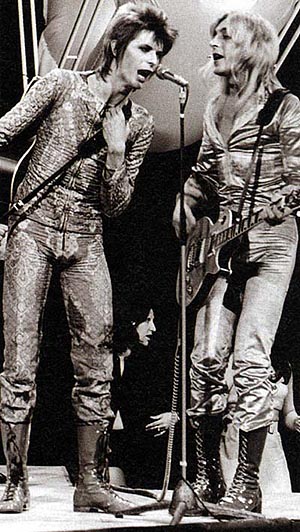
So glam was born, the next rebellion of the slightly-younger of the same generation (Bolan and Bowie were only 7 years younger than Lennon). T-Rex were the first and best and Bolan even did the courtesy of dying before he was thirty, cementing his legend as the leader of his pack, but Ziggy Stardust is the real hero of glam rock, and his roots are much, much older than rock n roll.


The writers J-K Husymans, Octave Mirbeau and Wilde had long satirised the hedonistic bent of fin-de-siècle France and Victorian Britain; glam was a recrudescence of this kind of flared-cuff-and-top-hats approach to aesthetics and desire, indulging as far as possible in all the bad taste glitter and glitz that could be found in a still-industrial Britain. Bowie/ Ziggy’s Rock n Roll Suicide even incorporated the same moral resolution that Wilde adopted in The Portrait of Dorian Gray - a debauched Ziggy is torn to pieces by his fans - although admittedly Jones/Bowie/Ziggy’s influence was a melange inspired by the youthful demise of Buddy Holly, Brian Jones, Morrison, Joplin and Hendrix. And the Americans landing on the moon. And Vince Taylor.

That glam was a revival of older music there can be no doubt: listen to the blues and 50s rock n roll riffs in T-Rex, cribbed from the States and cranked up to 10, and songs like Cadillac and Thunderwing (these aren’t British cars), they’re all poses (Bolan couldn’t even drive). The smooth ballading of Ziggy, cribbed from Sinatra and the 60s (and the 30s’ Wizard of Oz, in the case of Starman) and his rockers, which sound like Hendrix wrapped in foil and without the wah-wah and fuzzbox pyrotechnics, hark back to a simpler, purer era, stripped down to an essence bottled in prior decades.

The point here isn’t that pop will eat itself; glam was original, for all its references to aesthetic history. It’s that it was the first successful ‘heroising’ sub-genre of music, to permit a coinage. The rock n roll star as hero, as alien. Recall Baudelaire’s casting the role of poet in L’Albatross from the Flowers of Evil:


Often, to amuse themselves, the men of a crew
Catch albatrosses, those vast sea birds
That indolently follow a ship
As it glides over the deep, briny sea.


Scarcely have they placed them on the deck
Than these kings of the sky, clumsy, ashamed,
Pathetically let their great white wings
Drag beside them like oars.


That winged voyager, how weak and gauche he is,
So beautiful before, now comic and ugly!
One man worries his beak with a stubby clay pipe;
Another limps, mimics the cripple who once flew!


The poet resembles this prince of cloud and sky
Who frequents the tempest and laughs at the bowman;
When exiled on the earth, the butt of hoots and jeers,
His giant wings prevent him from walking.


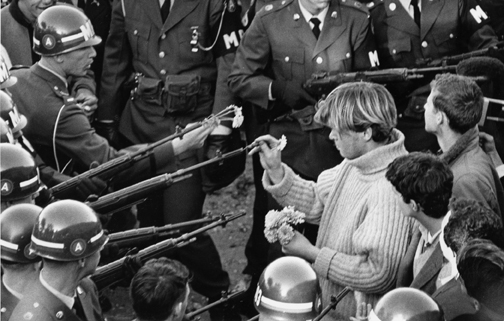
The poet as self-conscious outsider, raised above the common mass by his idealism and his sensitivity, alienated by the crude materialism of an increasingly affluent everyday life (the ahistorical amongst our readers will be shocked to read that pockets of Western Europeans in the 1860s thought their civilisation 'too affluent' prior to mass electrification, pre-radio, pre-TV, pre-Space Invaders, pre-Xbox, pre-Iphone, pre-Google glasses, but there it is). The sidereal hero of Bowie’s Starman, who instructs Ziggy to spread the message of love and hope on earth, is glam rock's classic exemplar. It is not the same kind of peace and love spread in the 60s, by a generation who thought they were changing the world:


Admittedly, Jim Morrison was of the same ilk, and the influence of Rimbaud and the Imagists is less oblique in his lyrics than in glam. The Doors were literary, to be sure, but they differ ideologically from glam in that Morrison wasn't interested in the idea of the rock star; he was interested in the idea of the mage, the writer and the dark poet, but happened to be a rock star in a rock band.

The colour TV - introduced into Britain in 1967- helped glam's cause immensely, as it had the psychedelic movement. Ziggy Stardust in monochrome would have looked like a bird shat on him, like a bad character from Dr Who; that would confuse the public, not enrage and inspire it:


Within a year, Roxy Music's Brian Eno had chinned Bowie sonically with Here Come the Warm Jets, at times redolent of Bonzo Dog Doo-Dah Band and their Carollian whimsy, in fact awash with clues about the aural horizon and the invention of ambient music (see previous posts). But Ziggy played guitar, and the kids saw it – and that’s what counted, in this decade of oil crises, failure of the greatest Western power to bring down a nation of peasant-communists and growing social unrest. Tune in, turn on and drop out had failed, apparently stabbed to death at Altamont in December '69 and vapourised in Britain by increasingly virulent bombings by the IRA. The communal hippy dream had faded; the decadent dream of glamour rock n roll heroism is what replaced it. Baudelaire would have approved.

Sunday, 22 April 2012

Music for Airports cont'd


From the will, the ‘I am’ of rock n roll heroism:

which was cruelly and wonderfully sent-up in punk


to the apparent absence of will; the tranquil, eastern resignation of Music for Airports, with its tentatively struck piano notes and ethereal female ‘ahh-ing’. It is music of the West’s late mysticism as yet unborn, in Spengler’s schema of history a feature of the wintertime of civilisation, but with a strictly Western spin – this is not music of the nothing, but music of the something. In Music for Airports, the Western ear hears not the formless Self of the Upanishads, nor the extinguished nirvana of the Dhammapada, but shapes and sounds and landscapes the eye has never seen! This music, this ambient soundscape is not an escape from the world but – a doorway to new worlds, worlds in which heroes are not shaped like rock stars (1978) or footballers (2012) and humanity is not ground down by a daily routine of manual labour (1978) or customer service (2012), but worlds which the word can barely grasp. The tracks are ‘called’ 1/1, 1/2, 2/1 and 2/2 for Christssake! Later ambients (including Eno’s sequels) would later succumb to the synaesthetic urge to coax the listener down a particular doorway with track titles like ‘An Arc of Doves’ and ‘Among Fields of Crystal.’ The pure form of (Western) ambient is boundless, seeking its way through a multiverse on the crest of barely-formed matter!
The macro-genesis of Ambient 1 in brief is therefore: the shrinking of the world (McLuhan, David Harvey) brought about by technological innovation (the Wrights) and by the entrepreneur’s pay-out for pursuing his own good (Adam Smith, etc ad nauseum) or actually rampant militarism with an incidental commercial implication leads to the discovery that it actually takes a lot of time to get people to board a plane in an orderly and administratively correct fashion (PanAm?), a time which required a new musak (Brian Eno), a musak for these strange hubs:


It is not the sound of airports - there are no sleepy montages of planes taking off and landing - but for airports, for the people who are in them, waiting, in the midst of slightly less real moments before actual real moments (which take place on arrival). Music of the interstices of modern life.

Tuesday, 17 April 2012

We is retronauting: Ambient 1: Music for Airports

BP wants to grasp, like Walter Benjamin’s Arcades Project, the past, to a degree limited by the information it can procure on the past, about the experiences of the past in its cultural-political-economic context, when it can be bothered. But it’s not Marxist.

This week/ today it’s Music for Airports.

For hipsters and dorks alike, Eno rules. His ambient album, coming two years after ambient collaborations with David Bowie, and after the fiddlings of La Monte Young, Cage, Penderecki, and the drugged noodlings of Tangerine Dream, is the focal point of the ambient explosion.

http://www.youtube.com/watch?v=ykJg-vE3k-E

In 1978, a few years after the modernising effects of the Equal Pay Act (in force 1975), decimalisation and EU membership (1973), the softening of England to women and foreigners, the decomposition of melodies into sounds, drones, textures became – interesting; beautiful, even. Eno composed public space music: functional, democratic, music for strolling and waiting in public venues. Benjamin would have approved: Eno is a flaneur’s composer, and the flaneur was the subject of the Arcades Project. But as the topic of wandering around enclosed shopping spaces became less interesting to us (the uglier the interiors of those buildings got), so perhaps music for airports will need to become music for space shuttles, for aliens – for whatever. As science fiction reminds us, we never get as far as we think as fast as we think.