Showing posts with label ideology. Show all posts

Saturday, 27 October 2012

Western cognitive dissonance

Classic sample from the BBC here. The dialectic runs as follows:

China is:

- the world's oldest extant state (dating back to at least 200BC);
- the fastest growing economy in the world now;

These are facts. But China is also very monocultural (this is a fact), and that is its greatest weakness (this is a value judgment).

That the former results from the latter is ruled out (presumably) as a result of the prevailing faith in mankind, underpinned by the political doctrine that we have 'strength through diversity.' Whoever believes that we have overcome religion is as deluded as this piece of reasoning. It is likely that we will never transcend faith; will never want to transcend faith. But let's not congratulate ourselves for going beyond religious faith. Secular faith is no better.

The brain is a funny thing. What did Celine say? That's right, he pissed on 'em:


‘The head is a kind of factory that doesn’t run exactly the way you’d like… imagine… two thousand billion neurons… all a complete mystery… where does that get you?... neurons left to their own resources! The slightest attack, your head goes haywire, you can’t pin down a single idea… you’re ashamed of yourself.’

Thursday, 28 June 2012

Politics and football

Anyone watching the Germany-Italy game was treated ere the kick-off to two declarations of faith, one by each captain, on the subject of respect and diversity. Only the auto-da-fe - perhaps publicly embarrassing someone who tweeted about "fags" when drunk or a foolhardy consumer facebooking  "the paki at the corner shop ripped me off again!" - is still missing from the melding of football and politico-religion.

Thursday, 10 May 2012

The New Arcades Project

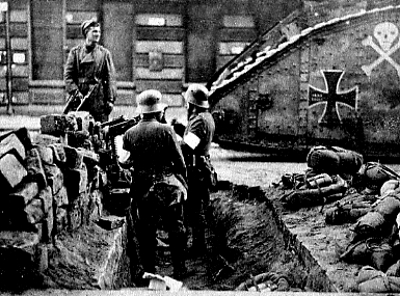
Burning Pyre is sick of the serviette badinage which passes for trench warfare between modern media talking heads. We’ve read of the time when men would beat and shoot each other to death over their opinions, viz. 1919:


What are we trying to say, ever so clumsily? That the cultural commentator and artist should stop whispering behind his napkin, embarrassed by a ballsy opinion, and say something real.

The New Arcades Project is an attempt to understand – hell: appreciate – art, politics, philosophy, history, economics, etc, etc, within a fragmented narrative context which is not history, but nevertheless seems like history. The rise of new media means that a new understanding can be developed which is not based in the art gallery or in the venerable book (which we continue to venerate, Amazon’s space-saving toy be damned) and, thanks to its brevity, need not be monotonically classicist or Marxist or fascist or capitalist or –ist at all. It can interweave competing, fragmented narratives to present a mosaic-like picture of events. It is the theory of history for an over-intellectualised, over-stimulated, over-fed generation who do not know what war or political rioting is, but who wish to understand the past more viscerally and without regard to political correctness or narrative structure than a million History Channel reconstructions, based on a phenomenological bootstrapping of personal experience to general, 'public' experience.

What the fuck does this mean?

We all remember the time, however distantly, a great record was released; an artwork seized the headlines; a terrorist event gripped our attention and our pity; a magnificent moment which was greater than our own personal agendas and felt, yes, like the Zeitgeist itself! This is the New Arcades Project.

Thursday, 26 April 2012

Famous historical fights: Gramsci vs. Il Duce

With the Murdochs back in the news againhegemony springs to mind, and with it the genesis of the idea.

Gramsci developed Marx and Engels’s theory of the economic superstructure, introducing the concept of hegemony into the general lexicon, and got locked up by the Duce for his troubles.
  

VS.


In brief - too, too brief - the theory goes: all aspects of life are determined materially (Marx & Engels, Die Deutsche Ideologie) which is the economic superstructure (Preface to a Contribution to a Critique of Political Economy), the controlling class of which employs the dissemination of information and judgments about values which justify and retrench that superstructure in terms of its desires (Gramsci, Prison Writings). The family – that is a bourgeois lie which produces new workers. The state – that is a bourgeois weapon to organise against the proles. Art – reflects the bourgeois lifestyle and the economic realities underpinning the apparently universal, objective ideals of Enlightenment.

According to Spengler’s history, the question of free will is the fundamental, sacrosanct dilemma of the Western ideology. Perhaps that is why Marxist determinism failed – fundamental inability to stomach the notion that all aspects of living are determined by the capitalist net. That, and the incessant obsession with revolution for its own sake (valorised in ’68; transformed in ’89 by the anti-Communist/ pro-capitalist revolutions across the Eastern Bloc). And the stupidity of the world envisaged by Marx post-revolution. Seven billion people ‘fishing, hunting and criticising art’ in a harmonious world beyond laws? Get real.

Is it a case of mistaking incidental consequences for deliberate entrapment by ideology? The proliferation of media can be seen as a direct and intentional consequence of 1. The capitalist’s desire for profit; or 2. The capitalist’s desire to fragment the desires of the working/ all classes – and I think the heterodox approach, including all classes in the critique of capitalism works better and sounds less like something from before the Modern Second Peloponnesian War – in order to water down resistance to the capitalist model of political economy. Doesn’t 1 logically precede 2? Hasn’t it been shown abundantly that ideologically-inspired adjustments to the economy will fail, and that the market determines itself?

Don’t get us wrong, Burning Pyre deplores the reductionism of our managerial capitalism, which sees life narrowly as the pursuit of economic interests, but we cannot imply that the ideology precedes the reality. Spirit/ Mind adjusts to material circumstances, Hegel taught. The making of money precedes the desire to make people think that they can only be happy by pursuing the ideology that making more money makes happy.

Hegel über Marxismus!* Duce oltre Gramsci!

On the other hand, we are perfectly willing to accept that something akin to Stockholm Syndrome prevents people from criticising the economic form of capitalism. How much harder is your job if you disagree with the principles on which it is founded, the incentive mechanisms used to ‘gee’ it along, and the organisational structures which are set up by the coal face, so to speak? Cognitive dissonance indeed.

So the Murdochs advance number 1 – making money – whilst influencing minds to their own agenda, which is not necessarily the capitalist one, other than by incidence. Propasphere is a much more accurate term to describe the illusion of objectivity under limited-consensus mass media.
 
*This tete-a-tete draws us into a debate about to what degree Hegel is the herald of liberal democratic capitalism of the Kojéve-Fukuyama variety.

Sunday, 27 January 2008

Blast from the past: Bertrand Russell

Bertrand Russell, 3rd Earl Russell, grandson of Prime Minister John Russell and godson of John Stuart Mill. Russell started as a logician and mathematician, but gave up producing original work in these fields after Wittgenstein's publication of the Tractatus. He then turned somewhat resignedly to popularising his views in philosophy, politics and ethics, and has been and is still seen as a proverbial wise man.

Russell dressed in the garb of a classic English liberal, but wore underneath wore the hair shirt of liberal Messianism. He advocated the disarmament of nuclear weapons as a means of preventing unnecessary deaths (the existence of which has prevented more than one conflict boiling over into a World War costing millions upon millions of lives); the intermarriage of the races as a means of eradicating prejudice (which surely would lead to more variations in race and therefore more racial strife than unfortunately exists, as a combination of American identity politics and Brazilian diversity would seem to suggest); and World Government as a means of ending the horror of inequality- therefore relieving David Rockefeller of the task of having any original beliefs of his own. What is interesting about these views is not their actual content, but the reasons why he held them. Russell's every opinion (at least in his later years, after he gave up logic) is saturated with pity for man and the inability to countenance opinions which differ in the slightest from his humanism.

Russell betrays the fervidness of his views perhaps most obviously in his History of Western Philosophy, in his assessments of Machiavelli and Nietzsche. On Machiavelli he writes: ‘His preference for popular government is not derived from any idea of “rights”, but from the observation that popular governments are less cruel, unscrupulous and inconstant than tyrannies.' This is, Russell thinks, an argument against the Italian. Again: 'There are chaotic periods during which obvious knavery frequently succeeds; the period of Machiavelli was one of them. In such times, there tends to be a rapidly growing cynicism, which makes men forgive anything provided it pays.' Finally, 'The world has become more like that of Machiavelli than it was, and the modern man who hopes to refute his philosophy must think more deeply than seemed necessary in the nineteenth century.’

And on Nietzsche:

‘I will admit that I agree with Nietzsche in thinking Dostoevsky's prostration [before God] contemptible’. Nietzsche never said or wrote such a thing (although he did about Pascal, whom Russell also mentions in this passage), and had nothing but praise for the Russian's psychological astuteness as demonstrated in Notes from Underground.

‘An ethic such as that of Christianity or Buddhism has its emotional basis in universal sympathy; Nietzsche’s in a complete absence of sympathy’. Nietzsche didn’t call for the abolition of sympathy, but in fact called to question the supra-ethical consequences of a moral doctrine which ‘feels that [man] cannot be completely happy so long as any living thing is suffering’ (ibid.) Nietzsche said that this was dangerous insofar as it evoked sweeping metaphysical conclusions from facts – an ethic rather redolent of Hume.

Most amusing – and demonstrative of my point about the obstinacy with which Russell held his views – is the imaginary dialogue between Nietzsche and Buddha. Russell is so obviously Buddha’s cutman in this philosophical fight over values that one begins to wonder how secure Russell’s sanity is. The grand narrative of the history of Western philosophy is paused for an imaginary sparring match between a nineteenth century German and a third century BC Indian. Russell even smuggles Jesus into ringside at one point.

The problem is not even necessarily that Russell miscasts Machiavelli and Nietzsche (and Kant and Hegel, among many others), but that his judgments hedge his own rather imperious evaluations of the world; he is so firm in his convictions that his mischaracterisations seem ridiculously imbalanced. Instead of weighing each thinker on his merits, Russell judges the history of Western philosophy according to its utility in his own messianic-moralistic worldview.

Russell is important as a social commentator because of his affinity of opinion with many of the leading figures of the present globalising revolution. I am certain that I know with which camp Russell would throw his lot in in the current debate over the range and influence of political correctness. Nevertheless, Russell, as a man of brilliant insight into logical and philosophical affairs, and with a great interest in improving the education and dignity of the common man, remains the last most important public intellectual in British history.

Sunday, 13 January 2008

The classics and us

Link here. Who cares about the classics these days? Almost certainly they are mistakenly to be viewed either as 'contemporaries' of our present middle-classes - the notion that, for instance, Aristotle's doctrines can be subjected to critique from the POV of an A-level student at a grammar school - or as contemporaries of our elites, which is how the Marxist and historicist intellectual perceives them. Plato belonged to the master class of aristocrats; we thronging bourgeois are descendants of the freemen and slaves. We also mistakenly think that the slave class - if it existed today - would necessarily be composed of the antipodes of the middle classes, 'chavs' and career criminals. However, the foremost error in judging the ancients is quite the obverse; it is in casting them as bearers of enlightenment, law and tolerance, as humanitarians and social democrats. There is ample evidence to suggest that the beauty and elegance of Plato and Aristotle's works existed in a time more like Berlin in 1945 than Arcadia. Try Thucydides - cf. the Melian speech to the Athenians.

An education in the classics is not actually a remnant of the bourgeois class’s need to reinforce its ideals by referring to the example of the hedonism and grandeur of the ancients. It is obvious that the ancients, far from enjoying supine luxury without strings, lived under the constant threat of the most terrible barbarism and gave nothing greater credence (not even life) than the abstract ideal of honour or dignitas. They are starkly to be contrasted with our contemporary middle class, which believes only in the pursuit of self-interest.

Saturday, 29 December 2007

Theses on the 'arms race' of rationalism

1. The ‘arms race’ that proceeds apace in all aspects of modern life, arises from the entrenchment of rationalism as the objective touch-stone of society, and characterises the motives of present-day social and economic life.

2. All other objective forms of valuation – religion, art, culture, race – have fallen by the wayside, either through design or the passing of the years.

3. We have arrived at the reductio ad absurdum of rationality. We cannot avoid it; we’re placed so firmly on the lines of rationalism that no other paradigm (religious, cultural, social, or political) can compete. All paradigms previously ascendent in the history of mankind are truncations of this one.

4. The arms race arises from Western thought and mechanics. Materially speaking, it is determined by the division of labour as the maximisation of output. Perhaps it has always been man’s goal to exploit to the fullest the resources both natural and human that are to hand. But it is our modern age that has perfected this goal. In perfecting this goal we have overcome the problem of scarcity that has hung over man’s head since the dawn of his time.

5. One can observe the gradual entrenchment of rationalism reaching back to the use of tools in the hunt. But let us take an example from our time: Shareholding and profit. On a microeconomics level, profit is the objective indicator of an end in itself for a business. Shareholders do not get into the business of owning shares for any other reason than that they wish to improve the health of the stocks they own. If one gets into business for ‘sentimental’ reasons, then he is destined for hard times. In the business world, all principles, morals and values are ancillary to the production of surplus value, determined as the rational end to which the energies of a business are employed. In business, profit is the objective indicator of an end in itself for a business. The macroeconomic goal of a business is to provide value and output to the general economy, which makes all modern life possible.

6. The arms race described here is an offshoot of the development of a self-conscious normativity, which was the first revaluation of values for modern Europe. We are living with this normativity problem today. It comes originally from the development of Reason nurtured by the increasing self-confidence of the bourgeois class, and latterly from the incredible proliferation of rationality and the subsequent diffuseness that this proliferation of Reason has given rise to. The ‘Dialectic of Enlightenment’ is nothing more than an account of this latter diffuseness of perspectives and material progress that Reason enables.

7. The arms race – as the unification of the management of resources, populations (as labourers) and discourses – cannot be stopped. This is not in itself a negative judgment, but an outline of the likelihood of success for those who oppose it.

Sunday, 16 December 2007

Geldof was one day late

'Tell me why I don't like Mondays?' Fuck that - would someone please tell me why I abominate Sundays?! It could be the residual religious dourness handed down over the generations, and which Nietzsche recognised (in Beyond Good and Evil) as a 'piece of English genius' - that is, if you make Sundays incredibly stifling, the worker is eager to get back to work. Perhaps my aversion is just biographical - I've never liked 'em. I actually prefer Mondays. Sundays is full of hopelessness and ; at least on a Monday my dread has dissolved. Late on Sunday night is the time when the private citizens peel themselves away from the privacy of their pursuits and prepare themselves for the return to the hive. It's like a bird migration. The return to work of millions of people who hate each other and dread their lives so much that they have no self-consideration, a self-loathing trait that is reiterated by having to internalise all of their joys and interests just as much as their frustrations and sense of outrage, is an artwork of the modern day. All acculturated leisure time revolves around keeping up morale, around that pop song or film that pats you warmly and empathically on the back and says 'Chin up, son, life is great when we're in this together' (decent film, actually). Morality, too, in a large part revolves around maintaining the morale of workers. Quote me on this - I'll return to it later. In researching this post, I came across this interesting, and inevitably American, campaign.

Tuesday, 11 December 2007

Irony

Following up on the humour/ satire angle, here is a classic statement of irony against the 'protest poets' (skip to between 1:16 - 1:31).

This is from the 1970s, bang in the middle of a load of postmodernism - Mutual Assured Destruction, the Sex Pistols and punk rock, swearing on TV, striking industrial workers protesting the transition of the industrial economy to the service-based economy (the objectivity of the machine workplace gives way to the subjectivity of language-based service workplace), Foucault, environmentalism, mass tourism, etc, etc. (someone could perhaps suggest some more factors?). The irony of 'Clive's' attack is that it reduces even the most well-meaning sentiment seen here - of the human yearning for freedom and equality - to ridicule. The implication is Nietzschean: the rights-fighter is just a crap version of someone who exercises rights; he desires power just as much as the one who possesses it, but seeks to obtain it not by 'open combat' of the virtues that that society recognises, but through appeal to the supposedly objective conditions that apply to man's nature itself, rather than to the 'external' customs of the society of the rights-fighter, the roots of which are arbitrary and enforced through social rules and codes. Whether these factors are in fact objective is another discussion entirely.

There are many examples of this kind of scepticism and opposition to the Enlightenment - a hidden history, in fact. It's a subject that captivates me, because we are still in some senses living in the discourse of Enlightenment.