Thursday, 10 May 2012

The New Arcades Project

Burning Pyre is sick of the serviette badinage which passes for trench warfare between modern media talking heads. We’ve read of the time when men would beat and shoot each other to death over their opinions, viz. 1919:


What are we trying to say, ever so clumsily? That the cultural commentator and artist should stop whispering behind his napkin, embarrassed by a ballsy opinion, and say something real.

The New Arcades Project is an attempt to understand – hell: appreciate – art, politics, philosophy, history, economics, etc, etc, within a fragmented narrative context which is not history, but nevertheless seems like history. The rise of new media means that a new understanding can be developed which is not based in the art gallery or in the venerable book (which we continue to venerate, Amazon’s space-saving toy be damned) and, thanks to its brevity, need not be monotonically classicist or Marxist or fascist or capitalist or –ist at all. It can interweave competing, fragmented narratives to present a mosaic-like picture of events. It is the theory of history for an over-intellectualised, over-stimulated, over-fed generation who do not know what war or political rioting is, but who wish to understand the past more viscerally and without regard to political correctness or narrative structure than a million History Channel reconstructions, based on a phenomenological bootstrapping of personal experience to general, 'public' experience.

What the fuck does this mean?

We all remember the time, however distantly, a great record was released; an artwork seized the headlines; a terrorist event gripped our attention and our pity; a magnificent moment which was greater than our own personal agendas and felt, yes, like the Zeitgeist itself! This is the New Arcades Project.

Sunday, 6 May 2012

Glam decadence: 1970s Britain and fin-de-siecle Paris


This is a continuation of our retronauting back to the 70s with Bernhard’s Correction (’75), Eno’s Ambient 1 (’78) with the glam roots of the decade.

This is what really kicked it off:


Men wearing makeup? Do well to note that this is what life in the early 70s was like:


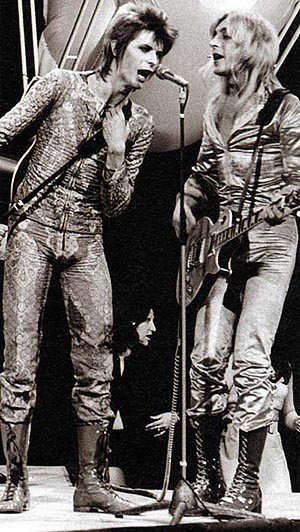
While glam rock just looks old-fashioned and silly to most people now, underlying its outward daftness is the desire not even twenty years after the creation of rock n roll to lionise stardom and to play with the concept of it. It wasn’t enough simply to be the star, to play the music, to sell out Shea Stadium – you had to differentiate yourself from the ordinary people and give vent to their (supposedly) subconscious desires to break free and live as if you had the money to do it. Like this:


So glam was born, the next rebellion of the slightly-younger of the same generation (Bolan and Bowie were only 7 years younger than Lennon). T-Rex were the first and best and Bolan even did the courtesy of dying before he was thirty, cementing his legend as the leader of his pack, but Ziggy Stardust is the real hero of glam rock, and his roots are much, much older than rock n roll.


The writers J-K Husymans, Octave Mirbeau and Wilde had long satirised the hedonistic bent of fin-de-siècle France and Victorian Britain; glam was a recrudescence of this kind of flared-cuff-and-top-hats approach to aesthetics and desire, indulging as far as possible in all the bad taste glitter and glitz that could be found in a still-industrial Britain. Bowie/ Ziggy’s Rock n Roll Suicide even incorporated the same moral resolution that Wilde adopted in The Portrait of Dorian Gray - a debauched Ziggy is torn to pieces by his fans - although admittedly Jones/Bowie/Ziggy’s influence was a melange inspired by the youthful demise of Buddy Holly, Brian Jones, Morrison, Joplin and Hendrix. And the Americans landing on the moon. And Vince Taylor.

That glam was a revival of older music there can be no doubt: listen to the blues and 50s rock n roll riffs in T-Rex, cribbed from the States and cranked up to 10, and songs like Cadillac and Thunderwing (these aren’t British cars), they’re all poses (Bolan couldn’t even drive). The smooth ballading of Ziggy, cribbed from Sinatra and the 60s (and the 30s’ Wizard of Oz, in the case of Starman) and his rockers, which sound like Hendrix wrapped in foil and without the wah-wah and fuzzbox pyrotechnics, hark back to a simpler, purer era, stripped down to an essence bottled in prior decades.

The point here isn’t that pop will eat itself; glam was original, for all its references to aesthetic history. It’s that it was the first successful ‘heroising’ sub-genre of music, to permit a coinage. The rock n roll star as hero, as alien. Recall Baudelaire’s casting the role of poet in L’Albatross from the Flowers of Evil:


Often, to amuse themselves, the men of a crew
Catch albatrosses, those vast sea birds
That indolently follow a ship
As it glides over the deep, briny sea.


Scarcely have they placed them on the deck
Than these kings of the sky, clumsy, ashamed,
Pathetically let their great white wings
Drag beside them like oars.


That winged voyager, how weak and gauche he is,
So beautiful before, now comic and ugly!
One man worries his beak with a stubby clay pipe;
Another limps, mimics the cripple who once flew!


The poet resembles this prince of cloud and sky
Who frequents the tempest and laughs at the bowman;
When exiled on the earth, the butt of hoots and jeers,
His giant wings prevent him from walking.


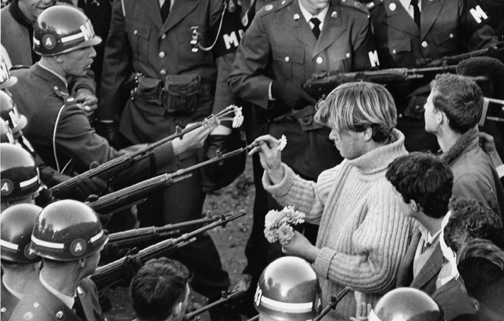
The poet as self-conscious outsider, raised above the common mass by his idealism and his sensitivity, alienated by the crude materialism of an increasingly affluent everyday life (the ahistorical amongst our readers will be shocked to read that pockets of Western Europeans in the 1860s thought their civilisation 'too affluent' prior to mass electrification, pre-radio, pre-TV, pre-Space Invaders, pre-Xbox, pre-Iphone, pre-Google glasses, but there it is). The sidereal hero of Bowie’s Starman, who instructs Ziggy to spread the message of love and hope on earth, is glam rock's classic exemplar. It is not the same kind of peace and love spread in the 60s, by a generation who thought they were changing the world:


Admittedly, Jim Morrison was of the same ilk, and the influence of Rimbaud and the Imagists is less oblique in his lyrics than in glam. The Doors were literary, to be sure, but they differ ideologically from glam in that Morrison wasn't interested in the idea of the rock star; he was interested in the idea of the mage, the writer and the dark poet, but happened to be a rock star in a rock band.

The colour TV - introduced into Britain in 1967- helped glam's cause immensely, as it had the psychedelic movement. Ziggy Stardust in monochrome would have looked like a bird shat on him, like a bad character from Dr Who; that would confuse the public, not enrage and inspire it:


Within a year, Roxy Music's Brian Eno had chinned Bowie sonically with Here Come the Warm Jets, at times redolent of Bonzo Dog Doo-Dah Band and their Carollian whimsy, in fact awash with clues about the aural horizon and the invention of ambient music (see previous posts). But Ziggy played guitar, and the kids saw it – and that’s what counted, in this decade of oil crises, failure of the greatest Western power to bring down a nation of peasant-communists and growing social unrest. Tune in, turn on and drop out had failed, apparently stabbed to death at Altamont in December '69 and vapourised in Britain by increasingly virulent bombings by the IRA. The communal hippy dream had faded; the decadent dream of glamour rock n roll heroism is what replaced it. Baudelaire would have approved.

Tuesday, 1 May 2012

Thomas Bernard's Correction: a review


1931-1989
 
He looked a bit like James May, but Bernhard wrote dark shit nothing to do with cars or Jeremy Clarkson.

This novel, two long paragraphs recounting the work, life and death of a scientist-writer-architect-philosopher loosely based on Wittgenstein and written in 1975, is firmly within the dark (post)modernist wave of post-WWII art; a quintessentially unfilmable novel which escapes into the dark interstices where the writer melts into his subject matter as if he himself were a palimpsest and then breaches the overlay - be it reminiscences of youth or Roithamer's recondite script on his life, his family, the sister whom he loved and the mysterious edifice, the Cone - and surfaces again to remind us that this is a novel with an apparently reliable narrator.

The subject of the story is Roithamer. The nameless narrator and Hoeller, the childhood friend in whose garret Roithamer found the courage to complete the Cone, are merely wallpaper, Hoeller interesting wallpaper, whose pleasure is to stuff birds late at night in his workshop - or is it? Roithamer is no pointy-headed mentalist-genius in the Hollywood style (Shine, A Beautiful Mind, Pollock), but a man whose genius we are told to accept through his accomplishing the apparently impossible feat of building a cone-shaped structure in the middle of the Kobernausser Forest. And accept it we do, because - there is nothing else to grasp in this novel.

If the narrator is a palimpsest, ever abrading his will from the narrative, then Roithamer is a vessel for Bernhard's reflections on inevitability.

Napoleon said that the ancient concept of fate is replaced in the modern era with policy. Bernhard reminds us here that policy is determined fatefully - by quirks (by being born in Altensam), by predispositions (to over-analyse), by family ('the Erdfing woman'); that is, inescapably.


So far so bleak. Possibly more popular, but not as funny as Celine (but then Bernhard wasn't right-wing), Bernhard falls into the trap of all classically depressed/ dark artists - if he ever played a practical joke in his life his credibility would be over, instantly. Think Beckett (all turtle necks and fierce stares from that vulture-like visage), Robert Smith, Van Gogh, Schiele, etc., po-faced artists (and others) who, if they ever cracked a joke to their public, I mean a really funny, possibly even crass joke, they would be done. It wasn't ever inevitable that Bernhard would step outside of the aesthetic world he had created for himself and tell such a joke. After all, he stayed within his slightly abstract, nihilistic milieu right to the end.

This novel is beautiful like a plastic room designed by H.R. Geiger would be beautiful; but you wouldn't want to sit in it for long.

Neither Celine nor Bernhard had children. They didn't believe in humanity enough.

'The nights, Roithamer said, are always the worst. Everything is blown up out of all proportion, no matter how insignificant, at night it becomes monstrous, the most insignificant, the most harmless thing there is grows monstrous at night and won't let a man like me or Roithamer or Hoeller sleep.'


Some materials:

http://www.thomasbernhard.org/

http://moreintelligentlife.com/node/852

Thursday, 26 April 2012

Famous historical fights: Gramsci vs. Il Duce

With the Murdochs back in the news again,  hegemony springs to mind, and with it the genesis of the idea.

Gramsci developed Marx and Engels’s theory of the economic superstructure, introducing the concept of hegemony into the general lexicon, and got locked up by the Duce for his troubles.
  

VS.


In brief - too, too brief - the theory goes: all aspects of life are determined materially (Marx & Engels, Die Deutsche Ideologie) which is the economic superstructure (Preface to a Contribution to a Critique of Political Economy), the controlling class of which employs the dissemination of information and judgments about values which justify and retrench that superstructure in terms of its desires (Gramsci, Prison Writings). The family – that is a bourgeois lie which produces new workers. The state – that is a bourgeois weapon to organise against the proles. Art – reflects the bourgeois lifestyle and the economic realities underpinning the apparently universal, objective ideals of Enlightenment.

According to Spengler’s history, the question of free will is the fundamental, sacrosanct dilemma of the Western ideology. Perhaps that is why Marxist determinism failed – fundamental inability to stomach the notion that all aspects of living are determined by the capitalist net. That, and the incessant obsession with revolution for its own sake (valorised in ’68; transformed in ’89 by the anti-Communist/ pro-capitalist revolutions across the Eastern Bloc). And the stupidity of the world envisaged by Marx post-revolution. Seven billion people ‘fishing, hunting and criticising art’ in a harmonious world beyond laws? Get real.

Is it a case of mistaking incidental consequences for deliberate entrapment by ideology? The proliferation of media can be seen as a direct and intentional consequence of 1. The capitalist’s desire for profit; or 2. The capitalist’s desire to fragment the desires of the working/ all classes – and I think the heterodox approach, including all classes in the critique of capitalism works better and sounds less like something from before the Modern Second Peloponnesian War – in order to water down resistance to the capitalist model of political economy. Doesn’t 1 logically precede 2? Hasn’t it been shown abundantly that ideologically-inspired adjustments to the economy will fail, and that the market determines itself?

Don’t get us wrong, Burning Pyre deplores the reductionism of our managerial capitalism, which sees life narrowly as the pursuit of economic interests, but we cannot imply that the ideology precedes the reality. Spirit/ Mind adjusts to material circumstances, Hegel taught. The making of money precedes the desire to make people think that they can only be happy by pursuing the ideology that making more money makes happy.

Hegel über Marxismus!* Duce oltre Gramsci!

On the other hand, we are perfectly willing to accept that something akin to Stockholm Syndrome prevents people from criticising the economic form of capitalism. How much harder is your job if you disagree with the principles on which it is founded, the incentive mechanisms used to ‘gee’ it along, and the organisational structures which are set up by the coal face, so to speak? Cognitive dissonance indeed.

So the Murdochs advance number 1 – making money – whilst influencing minds to their own agenda, which is not necessarily the capitalist one, other than by incidence. Propasphere is a much more accurate term to describe the illusion of objectivity under limited-consensus mass media.
 
*This tete-a-tete draws us into a debate about to what degree Hegel is the herald of liberal democratic capitalism of the Kojéve-Fukuyama variety.

Tuesday, 24 April 2012

Ivor Fox Frenzied Attack: a (limited) retrospective

IFFA were a duo of musical and video geniuses who fired up the "no-fi no-lie" genre to limited success (64 views on YouTube is shit, basically). Wither away into musical obscurity, o IFFA, you greatest-named band of all time, but let this be a tribute which burns still on our pyre:


Sunday, 22 April 2012

Music for Airports cont'd


From the will, the ‘I am’ of rock n roll heroism:

which was cruelly and wonderfully sent-up in punk


to the apparent absence of will; the tranquil, eastern resignation of Music for Airports, with its tentatively struck piano notes and ethereal female ‘ahh-ing’. It is music of the West’s late mysticism as yet unborn, in Spengler’s schema of history a feature of the wintertime of civilisation, but with a strictly Western spin – this is not music of the nothing, but music of the something. In Music for Airports, the Western ear hears not the formless Self of the Upanishads, nor the extinguished nirvana of the Dhammapada, but shapes and sounds and landscapes the eye has never seen! This music, this ambient soundscape is not an escape from the world but – a doorway to new worlds, worlds in which heroes are not shaped like rock stars (1978) or footballers (2012) and humanity is not ground down by a daily routine of manual labour (1978) or customer service (2012), but worlds which the word can barely grasp. The tracks are ‘called’ 1/1, 1/2, 2/1 and 2/2 for Christssake! Later ambients (including Eno’s sequels) would later succumb to the synaesthetic urge to coax the listener down a particular doorway with track titles like ‘An Arc of Doves’ and ‘Among Fields of Crystal.’ The pure form of (Western) ambient is boundless, seeking its way through a multiverse on the crest of barely-formed matter!
The macro-genesis of Ambient 1 in brief is therefore: the shrinking of the world (McLuhan, David Harvey) brought about by technological innovation (the Wrights) and by the entrepreneur’s pay-out for pursuing his own good (Adam Smith, etc ad nauseum) or actually rampant militarism with an incidental commercial implication leads to the discovery that it actually takes a lot of time to get people to board a plane in an orderly and administratively correct fashion (PanAm?), a time which required a new musak (Brian Eno), a musak for these strange hubs:


It is not the sound of airports - there are no sleepy montages of planes taking off and landing - but for airports, for the people who are in them, waiting, in the midst of slightly less real moments before actual real moments (which take place on arrival). Music of the interstices of modern life.

Wednesday, 18 April 2012

Three Philosophical Conceptions of Causality

Socratic Law of Causality
Everything that happens, happens for a reason; that is, it is a fact that can be accounted for (Theaetetus, 201d).

Galilean Law of Causality
Everything that happens, happens because it is caused physically to happen.

Nietzschean Law of Causality
Everything that happens can be traced back to a 'discourse'; - although this is not a word Nietzsche used (neither Habermas's Diskurs nor Heidegger's Rede). This discourse arises in the will to power.

Both Socrates' 'accounts' and Galileo's concept of physical cause (Will to Power: 551) are manifestations of a discourse of will to power in which penetrating understanding and the instrumentalisation of the world are aspects of the fundamental principle of individuation and its desire for self-actualisation that ‘determines’ in a sense the basis of its functioning.

In being filtered through the individual’s will to power, causes and effects are matched on the basis of an epistemological schema chosen on the basis of prior demands. Ockham’s razor was one such schema, as was Einstein’s dictum that an explanation should be as simple as possible and no simpler. Schema themselves come from the will to power. Some scholars have suggested not unreasonably that the will to power can be traced back to evolutionary or biological demands (e.g., Peter Poellner), although Nietzsche himself cautioned against biological literalism (it's an interpretative schema, remember?) and proferred the metaphor instead.

Why did he fear going beyond the metaphor? There are two reasons; firstly, because he was a realist in observing the constant revisability of the sciences; secondly, because that way idols lie littering the landscape like a thousand Ozymandiases, and there can be only one poem as good as Shelley's by which to remember them. Nietzsche preached what he preached, even if his practice came up short.

But this is the difficulty of rational life – establishing laws and choosing criteria for values.